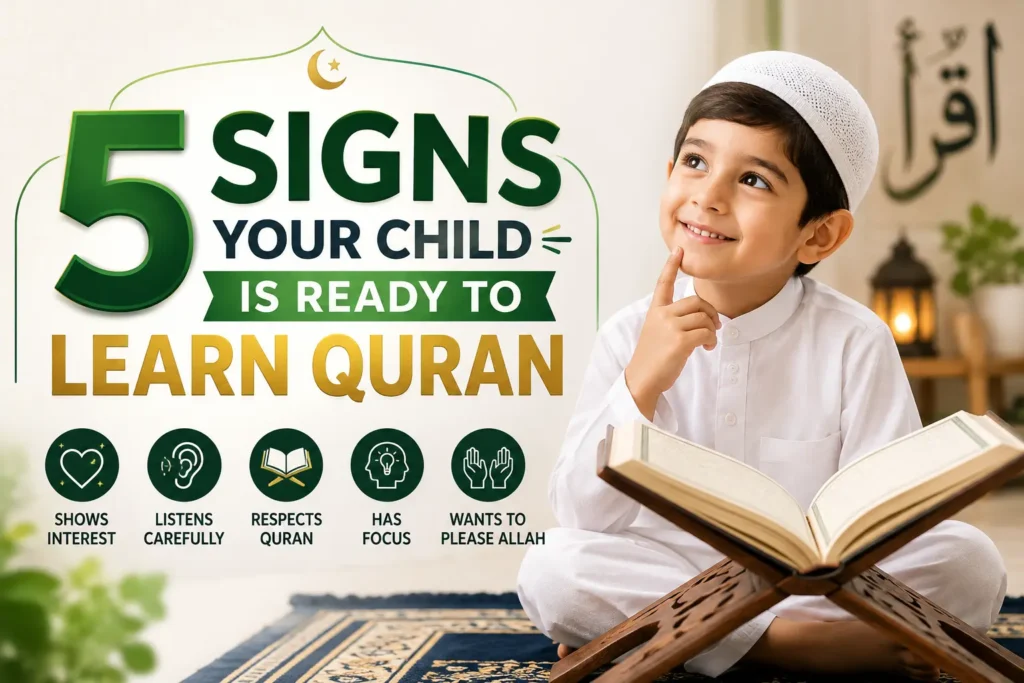
Every child develops at their own pace, so there is no single age at which every child must begin learning the Quran. Some children may show interest at a young age, while others may need more time to develop the attention, communication, and learning habits needed for regular Quran lessons.
Instead of focusing only on age, parents can look for certain signs that indicate their child may be ready. Recognizing these signs can help parents introduce Quran learning in a way that feels positive, comfortable, and age-appropriate.
1. Your Child Can Focus on One Activity for a Short Period
One of the first signs of readiness is the ability to sit and focus on a simple activity for a few minutes. Your child does not need to concentrate for a long lesson. Even a short period of focused attention can be a good starting point.
For example, if your child can listen to a short story, complete a simple puzzle, practice letters, or follow a short activity without constantly moving on to something else, they may be ready for short Quran lessons.
Parent tip: Start with short sessions and gradually increase the learning time as your child becomes more comfortable.
2. Your Child Shows Interest in the Quran
Interest is one of the strongest indicators that a child may be ready to begin learning. Perhaps your child hears Quran recitation at home, asks questions about it, tries to repeat verses, or wants to sit with family members during Quran time.
When children show curiosity, parents can use that natural interest as an opportunity to introduce learning.
Rather than forcing a long lesson, start by making Quran time familiar and positive.
3. Your Child Can Follow Simple Instructions
Quran learning often involves simple instructions such as listening, repeating, looking at a particular letter, or correcting pronunciation.
A child who can understand and follow basic instructions may find it easier to participate in a structured Quran lesson.
For example, if you say, “Listen and repeat after me,” and your child understands what to do, this can be a positive sign of learning readiness.
4. Your Child Is Developing Basic Language and Letter Skills
Children do not need to be fluent readers before starting Quran learning. However, basic familiarity with letters, sounds, and language can make the learning process easier.
If your child is beginning to recognize letters, distinguish sounds, or understand basic reading activities, they may be ready to start learning the Arabic alphabet and Quran reading step by step.
Important: Parents shouldn’t wait for their child to become a strong reader before introducing Quran learning. Lessons can be adapted to the child’s current ability.
5. Your Child Can Learn Without Becoming Overwhelmed
Perhaps the most important sign is whether your child can participate in a short learning session without becoming consistently frustrated or overwhelmed.
Some mistakes are completely normal. Children are learning something new, so they will naturally forget letters, mispronounce sounds, or need repeated explanations.
The goal is not perfection from the beginning. A child who is willing to try again, listen, and practice, even after making mistakes,is showing an important readiness for learning.
What If My Child Isn’t Showing All 5 Signs?
Parents may wonder whether they should wait if their child does not show every sign. In most cases, readiness isn’t an all-or-nothing decision.
A child might be interested in the Quran but have a short attention span. Another child might focus well but have little previous exposure to Arabic letters. These differences are normal.
Instead of waiting for every sign, parents can begin with very short, gentle activities and observe how their child responds.
What Is the Best Age to Start Learning the Quran?
There isn’t one perfect age for every child. Readiness depends on factors such as attention, communication, interest, and the child’s individual development.
Younger children can begin with simple activities such as listening to recitation, recognizing Arabic letters, and repeating short sounds. As they grow, lessons can gradually include reading, Tajweed, memorization, and understanding.
The focus should be on creating a positive foundation rather than rushing children through a fixed curriculum.
How Parents Can Prepare a Child for Quran Learning
Before starting formal lessons, parents can create a simple Quran-friendly environment at home.
Try these simple steps:
- Set aside a regular Quran time.
- Let your child hear the Quran recitation.
- Introduce Arabic letters gradually.
- Read short Surahs together.
- Keep early lessons brief.
- Praise effort rather than perfection.
- Choose a teacher who understands how to teach children.
Signs You May Need to Slow Down
Readiness can change from day to day. If your child is consistently exhausted, frustrated, or unable to engage with the lesson, it may be better to shorten the session or try again at another time.
A positive learning experience is more valuable than forcing a child to complete a specific amount of material.
How to Choose the Right Quran Teacher for Your Child
Once you feel your child is ready, the next step is finding an appropriate learning environment.
A good children’s Quran teacher should be patient, encouraging, and able to adapt lessons according to the child’s age and ability. Parents can also ask how the teacher handles mistakes, maintains attention, and communicates progress.
This section can naturally target keywords such as “Quran teacher for kids,” “online Quran classes for children,” and “best Quran classes for kids.”
Conclusion
Knowing when your child is ready to learn the Quran is less about choosing a specific age and more about understanding your child’s individual development. Interest, short periods of focus, the ability to follow instructions, developing language skills, and a willingness to practice can all indicate that your child is ready to begin.
The best approach is to start gently, keep expectations realistic, and make Quran learning a positive experience. With patience and consistency, children can gradually develop the skills and confidence they need to build a lasting connection with the Quran.
FAQs
- What is the best age to start learning the Quran?
There is no fixed age. A child can start when they show interest, can follow simple instructions, and are ready for short learning sessions.
- How do I know if my child is ready for Quran classes?
Look for signs such as short attention span, interest in Quran, ability to follow instructions, and willingness to practice.
- Can children learn the Quran without knowing Arabic?
Yes. Children can first learn Arabic letters, sounds, and basic reading skills before gradually developing their Quran reading.
- Should my child learn Qaida before the Quran?
Yes, Qaida can provide a useful foundation by teaching Arabic letters, sounds, and basic reading rules.
- How long should a child’s Quran lesson be?
For young children, 10–15 minutes can be a good starting point. The duration can increase as their focus and confidence improve.
- What if my child doesn’t enjoy Quran lessons?
Try shorter sessions, positive encouragement, and an age-appropriate teaching approach. A patient teacher can also make learning more enjoyable.